 War of the Ecosystems
Request Strategy Session
War of the Ecosystems
Request Strategy Session
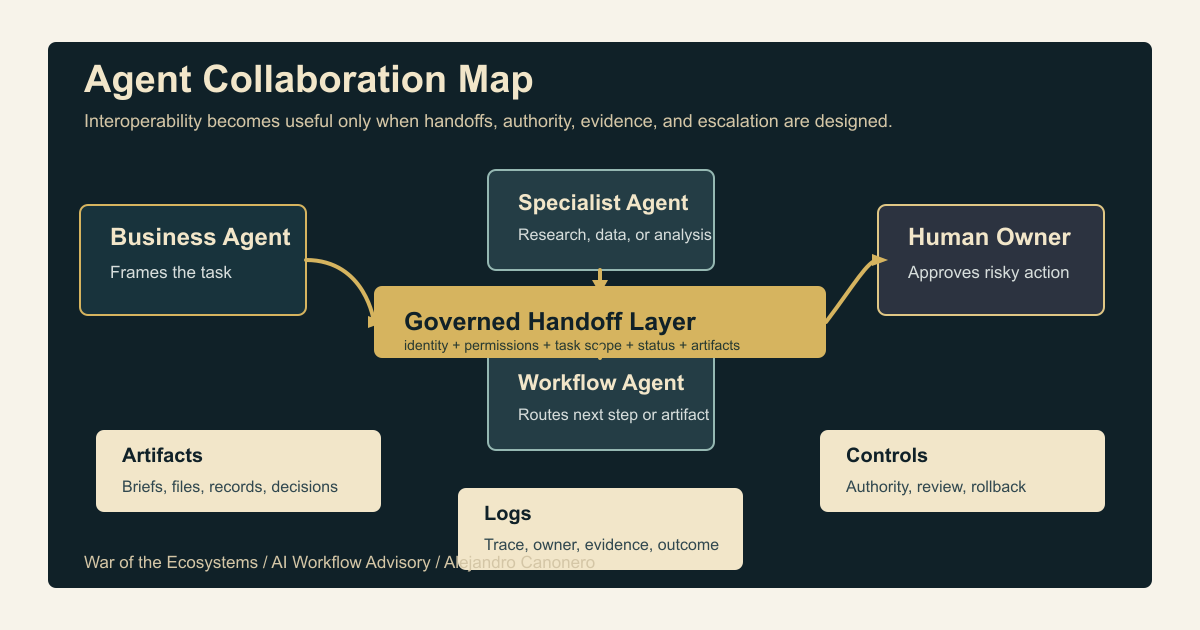
The next AI workflow problem is not whether one agent can answer a prompt.
It is whether several agents can coordinate real work without losing command.
Companies are quickly moving from isolated assistants to specialized agents. One agent may qualify a lead. Another may search company knowledge. Another may prepare a finance view. Another may draft a support reply. Another may operate inside a vendor platform. At first, each agent looks like a productivity tool. Very soon, the strategic question changes: can these agents discover each other, hand off tasks, exchange context, return artifacts, escalate risk, and leave enough evidence for a human leader to trust the result?
That is why Google's Agent2Agent protocol is an important market signal. It points to a world where agents do not sit in separate rooms waiting for a prompt. They can describe capabilities, exchange messages, manage tasks, return artifacts, and support longer-running work across boundaries.
But this is where leaders must be careful.
Interoperability is not governance.
A protocol can help agents talk. It does not decide whether they should talk, what they are allowed to move, which system of record they can touch, who owns the outcome, or when a human commander must step in.
That distinction is the heart of the War of the Ecosystems connection.
In a product-versus-product world, the question was simple: which tool is better? In an ecosystem-versus-ecosystem world, the question is harder: which operating system can coordinate more capabilities, more partners, more data, more workflow control, and more trust without collapsing into chaos?
The strongest side is not the side with the most agents. It is the side with the best command layer.
From Agent Demos To Ecosystem Command
The War of the Ecosystems framework starts with a blunt premise: markets are no longer won only by isolated products. They are won by ecosystems that control identity, user adoption, data, workflows, partner leverage, and customer access.
Agent-to-agent collaboration belongs inside that same doctrine.
If every vendor builds agents, the agent itself stops being the differentiator. The strategic advantage moves to the ecosystem that can coordinate agents across the work. That includes the handoff from marketing to sales, from sales to finance, from support to engineering, from operations to compliance, from research to executive decision, and from customer signal to product response.
This is where platform envelopment becomes visible. A large platform does not need to build the best specialist agent in every category. It can surround the workflow by controlling the identity layer, the context layer, the collaboration standard, the marketplace, the data permissions, and the place where work is approved. Once the handoff layer sits inside one platform's command structure, every smaller tool must either integrate into that command structure or fight uphill for relevance.
For smaller and mid-sized companies, the answer is not to copy the platform's entire arsenal. The answer is to define a minimum viable ecosystem.
A minimum viable ecosystem is not a pile of tools. It is the smallest set of capabilities, data sources, controls, owners, and feedback loops required to produce a real outcome. In agent terms, that means a company should not begin by asking, "How many agents can we deploy?" It should ask, "Which handoff creates the most delay, rework, risk, or lost revenue, and what minimum agent collaboration would improve it?"
The Ecosystem Commander role then becomes practical. Someone must define intent. Someone must decide which agent can request work, which agent can accept it, what context can move, what artifact must be returned, where approval sits, which logs matter, and which metric proves that the handoff improved the business.
Without that command layer, interoperability can amplify confusion.
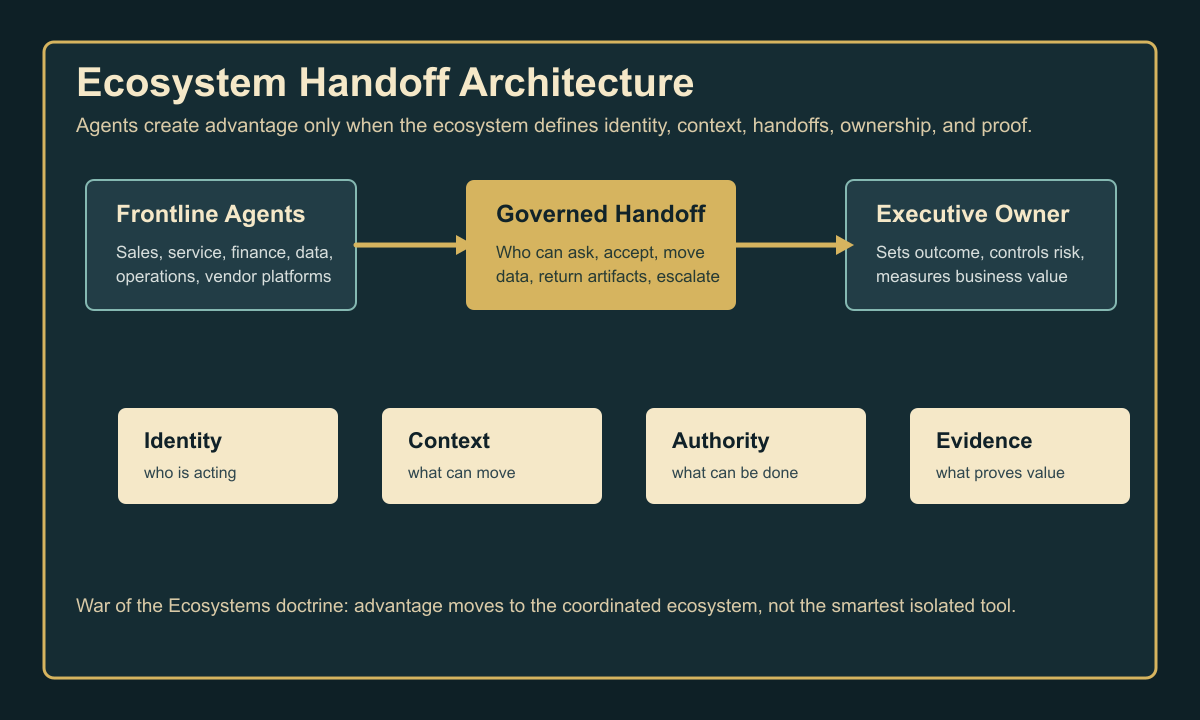
The Battlefield Example: Operation Anaconda
The military example should be real, not decorative. A useful case is Operation Anaconda in Afghanistan's Shah-i-Khot Valley in March 2002.
Army University Press describes Anaconda as the largest U.S. combat operation in Afghanistan as of 2 March 2002. It involved coalition troops, special operations forces, Afghan allies, rugged mountain terrain, enemy positions in caves and ridges, ground units taking heavy fire, and close air support becoming essential once the fight developed differently from the clean plan.
The Department of Defense air-power case study is even more useful for this article's point. It describes Anaconda as a demanding test of joint land-air integration. Bombers, fighters, helicopters, and AC-130 gunships delivered close air support into a very small battle area, while friendly troops and controllers were also operating in that same compressed space. The report notes that deconfliction and coordination of fire support were challenging, and that the battle exposed stress points in joint warfighting.
That is the lesson. The issue was not whether aircraft, ground forces, controllers, and headquarters had ways to communicate. They did. The issue was whether all those units had a coherent enough shared picture, command structure, deconfliction process, targeting discipline, and feedback loop while the situation was changing under fire.
Anaconda was ultimately successful, but it is remembered precisely because success required painful coordination across components. Air support had to respond quickly to troops under pressure. Controllers had to prioritize requests. Headquarters needed a usable picture of what was happening. Friendly positions, aircraft movement, enemy fire, terrain, weather, and time pressure all had to be managed together.
That is the right military lens for agent collaboration: communication is not command.
An agent that discovers another agent is like a unit finding a support channel. An agent that sends context is like a field report. An agent that asks another agent to act is like a request for close support. The returned artifact is the mission result. The log is the after-action report. Human approval is the command checkpoint. Deconfliction is the rule that prevents one automated action from creating risk for another part of the business.
If the company only builds the radio network, agents will communicate faster than leaders can command them.
If the company builds the command layer, agents can collaborate inside a defined operating model.
That is the strategic difference.
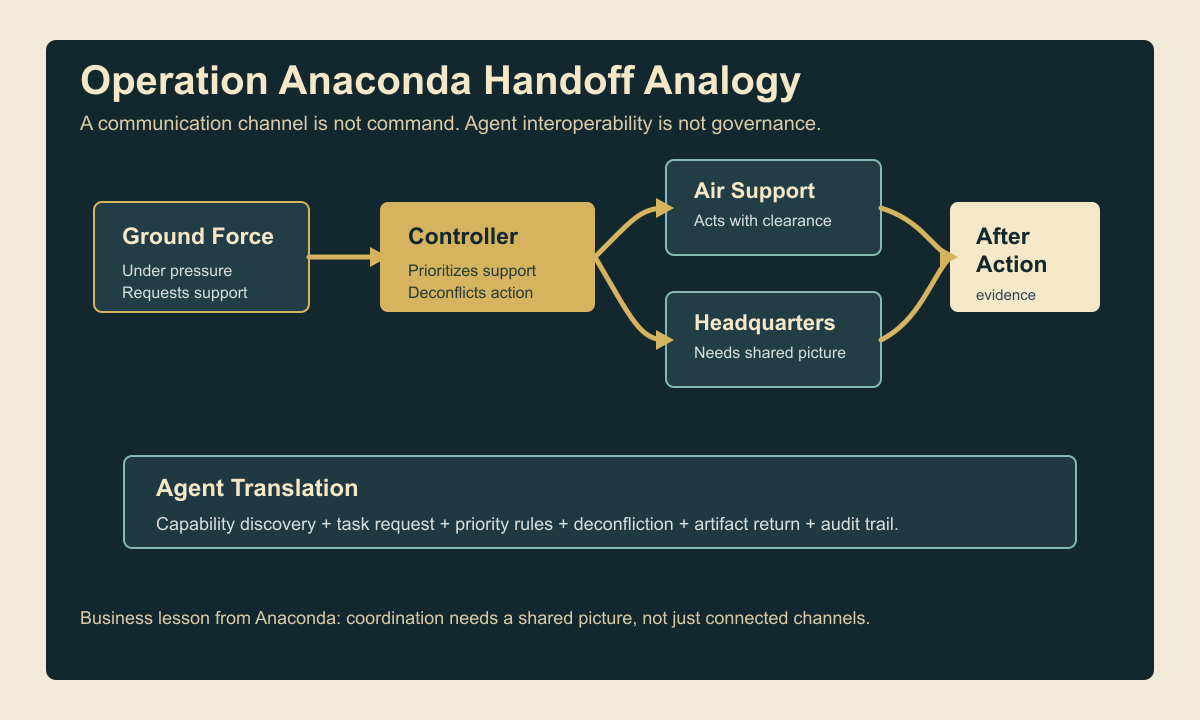
What A2A Actually Signals
Agent2Agent, usually shortened to A2A, matters because it treats agent collaboration as an infrastructure problem. The protocol is designed so agents can expose what they can do, exchange messages, manage task state, return artifacts, and coordinate work over time.
That is a meaningful shift. Enterprise AI is moving beyond "ask one assistant a question." The market is heading toward multiple agents working across business functions and vendor ecosystems.
The A2A specification also shows why this cannot be reduced to a branding race. The important concepts are capability discovery, task management, messages, artifacts, authentication, and status. These are not cute features. They are the plumbing of cross-agent work.
Still, leaders should not mistake plumbing for strategy.
A2A can help agents collaborate. Model Context Protocol, often shortened to MCP, helps connect AI systems to tools and data sources. Both are part of the emerging AI workflow infrastructure. But neither one, by itself, tells a company which workflow deserves automation, which data is safe to expose, which agent has authority, which exception requires review, or which business metric should improve.
“But neither one, by itself, tells a company which workflow deserves automation, which data is safe to expose, which agent has authority, which exception requires review, or which business metric should improve.”
, Dr. Alejandro Canonero, DBA, author of War of the Ecosystems
Protocol enables contact. Context enables relevance. Authority enables action. Evidence enables trust. Outcomes justify scale.
Leave out any one of those layers and the system becomes fragile.
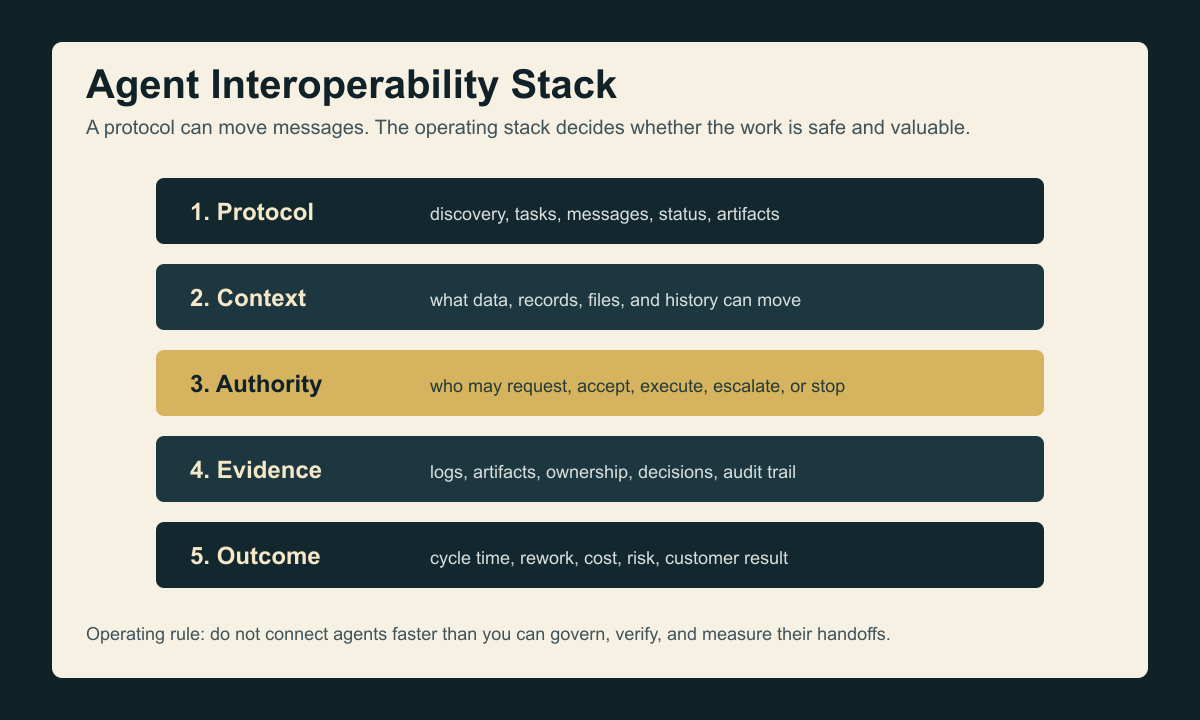
Where Clients Should Start
The wrong starting point is "let us connect all agents."
That sounds ambitious, but it is usually undisciplined. It creates a big architecture before the business has proved a small command loop.
The better starting point is one high-friction handoff.
A sales-to-proposal handoff is one example. The first agent gathers account context, opportunity history, requirements, objections, and competitive notes. A second agent drafts the proposal structure or pricing support. A human owner approves the final argument and commercial position. The system logs what context moved, which source records were used, what artifact came back, who approved it, and whether proposal cycle time or win quality improved.
A support-to-engineering escalation is another example. A support agent summarizes the customer issue, affected product area, severity, history, and attempted fixes. An engineering triage agent checks known issues, relevant documentation, and release context. A human owner approves prioritization or customer communication. The success metric could be fewer back-and-forth cycles, faster escalation clarity, or better customer response time.
A finance-close handoff is another candidate. One agent prepares variance context and missing inputs. Another agent drafts explanations or checks policy alignment. A human owner approves the final close package. The control point is obvious: finance workflows need traceability, source evidence, access rules, and escalation.
None of these examples require a company to become an AI laboratory. They require a disciplined minimum viable ecosystem: two or three agents, a defined workflow, a known human owner, a few trusted data sources, an approval point, and measurable evidence.
That is enough to learn.
It is also enough to avoid the most common mistake: scaling autonomy before command.
The Three Maps Leaders Need
The first map is the ecosystem handoff architecture. It shows which agents sit inside the workflow, where the governed handoff layer lives, and which executive owner is accountable for the result. It also makes the platform control surfaces visible: identity, context, authority, and evidence. This is where the War of the Ecosystems lens matters. If a company cannot see who controls these surfaces, it cannot see where strategic dependence is forming.
The second map is the Operation Anaconda handoff analogy. It keeps leaders honest. A communication channel is not command. A request is not approval. A returned file is not an outcome. A completed task is not proof of value. The map forces the business to define shared picture, deconfliction, escalation, and after-action evidence before agents begin to coordinate live work.
The third map is the agent interoperability stack. It separates the layers that vendors often blur together: protocol, context, authority, evidence, and outcome. A company can then ask a better question at each layer. What standard lets agents exchange tasks? What context can safely move? Who can authorize action? What evidence is preserved? What business result proves the handoff worked?
These three maps turn agent interoperability from a technical conversation into an operating model.
The Risk: Faster Handoffs Can Spread Bad Decisions Faster
Agent collaboration can create leverage. It can also spread mistakes.
If the first agent misreads context, the second agent may act on bad assumptions. If permissions are too broad, sensitive data may move where it should not. If task scope is vague, agents may complete the wrong work. If logs are weak, leaders may not know which agent made which decision. If human review is missing, risky actions may happen faster than the business can stop them.
This is why governance cannot be added after the fact.
Governance is not a compliance wrapper. It is part of the workflow design. It defines what agents are allowed to know, ask, do, return, escalate, and prove.
The executive question is not, "Can agents talk to each other?"
The executive question is, "Can our ecosystem command the handoff?"
The Strategic Lesson
Agent-to-agent interoperability will matter. The companies that ignore it may end up with isolated AI tools that cannot coordinate useful work. But the companies that embrace it blindly may create a faster, more confusing, less accountable operating environment.
The winning move is disciplined coordination.
Start with one handoff. Build the minimum viable ecosystem around it. Define the command layer. Use the protocol where it helps. Connect context only where it is safe. Assign human ownership. Preserve evidence. Measure whether the handoff improved the business.
That is how agent collaboration becomes strategy.
Not because agents can talk.
Because the ecosystem can command.
If your company loses time at handoffs between teams, systems, vendors, approvals, or data sources, that is where agent collaboration should be mapped first.