 War of the Ecosystems
Request Strategy Session
War of the Ecosystems
Request Strategy Session

Korea taught that the better machine can lose to the faster decision loop. Ukraine teaches the next lesson: even the better drone loses without the ecosystem that senses, adapts, manufactures, trains, jams, protects, and learns faster than the enemy.
01 The second case study
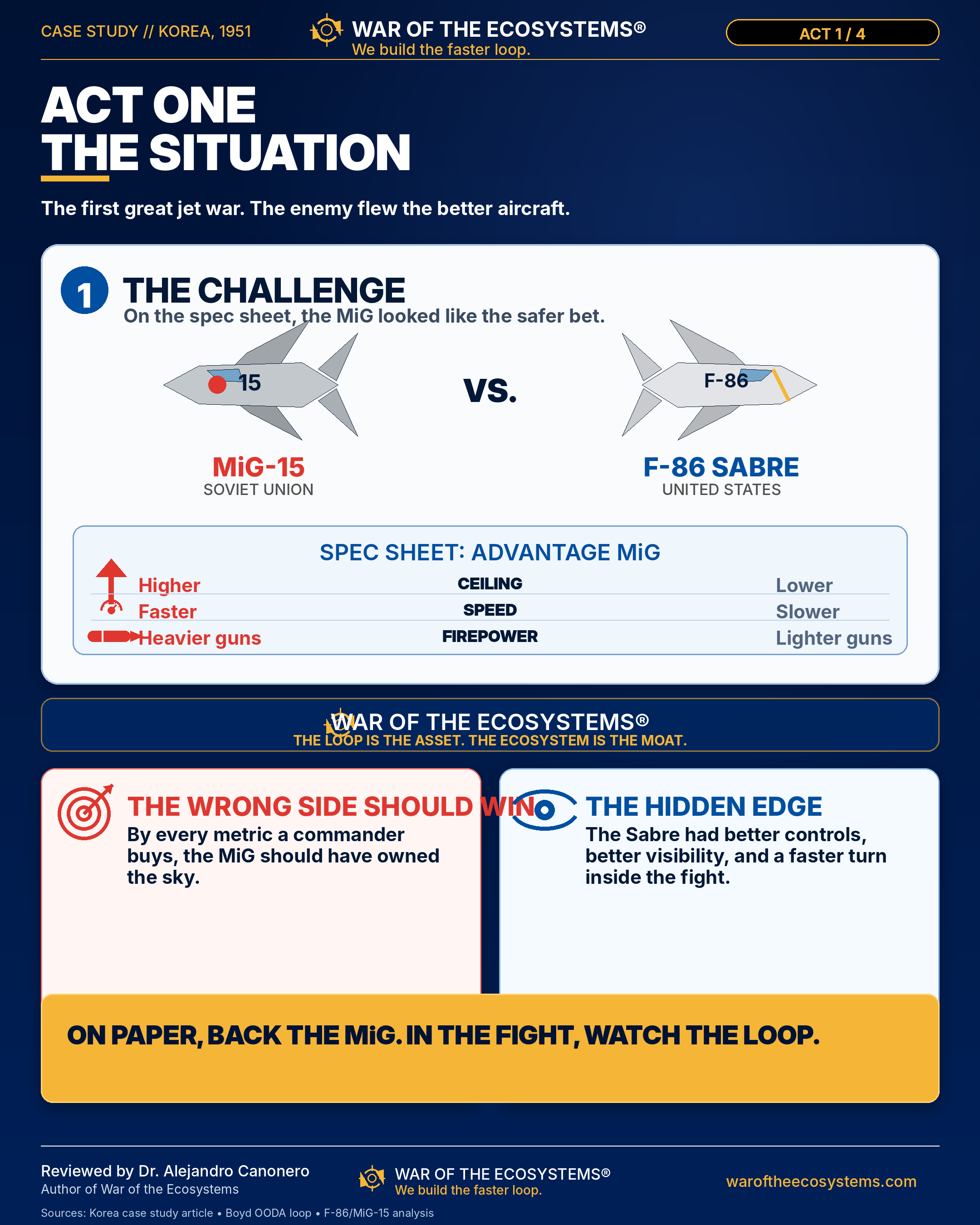
Over Korea, the better jet lost the sky. Over Ukraine, the better drone can lose the battlefield. Together they expose the same strategic law: do not confuse the weapon with the system that makes the weapon decisive.
The Soviet MiG-15 looked superior on paper. Yet the F-86 Sabre kept winning because it was part of a superior human-machine decision loop. The canopy, controls, pilots, training, doctrine, and speed at which a pilot could observe, orient, decide, and act mattered more than the static beauty of the machine.
The better object loses to the better loop. The better loop loses to the better ecosystem.

02 Ukraine extends the doctrine
The visible story is drones: first-person-view drones, naval drones, reconnaissance systems, jammers, sensors, and software-defined targeting. But the wrong conclusion is easy: buy more drones.
A drone is not a strategy. It is a node inside an adaptation ecosystem. Procurement, battlefield feedback, decentralized manufacturing, training, logistics, targeting data, electronic warfare, and counter-drone learning are the real system. The drone is the artifact. The ecosystem is the weapon.
03 The artificial-intelligence translation
Companies make the same mistake with artificial intelligence. They buy the model, compare the benchmark, and debate which agent is better. They measure the plane and forget the sky.
The real questions are operational:
- Can the company learn from every interaction?
- Can it convert expert correction into better workflows?
- Can it connect models to clean data, governed tools, human review, and measurable outcomes?
- Can it deploy faster without losing control?
04 Build the minimum viable artificial-intelligence ecosystem
1 Define the mission
Choose a real battlefield: a bounded business outcome whose quality, speed, and risk can be measured.
2 Build a decision loop
Capture failures, expert corrections, customer signals, and operational outcomes so each cycle improves the next.
&ldqu Capture failures, expert corrections, customer signals, and operational outcomes so each cycle improves the next.”
, Dr. Alejandro Canonero, DBA, author of War of the Ecosystems
3 Integrate the work
Connect artificial intelligence to the systems where work lives. An isolated demonstration is not an operating capability.
4 Create governance
Define approvals, decision rights, auditability, and the points where human authority must remain in command.
5 Establish an adaptation cadence
Improve weekly, not annually. The learning rate of the ecosystem becomes the competitive rate of the enterprise.
05 The doctrine
Korea teaches that speed of orientation beats technical superiority. Ukraine teaches that speed of ecosystem adaptation beats tool accumulation.
The plane is not enough. The drone is not enough. The model is not enough. Command the loop. Build the ecosystem. Then the tool becomes a weapon.