 War of the EcosystemsRequest Strategy Session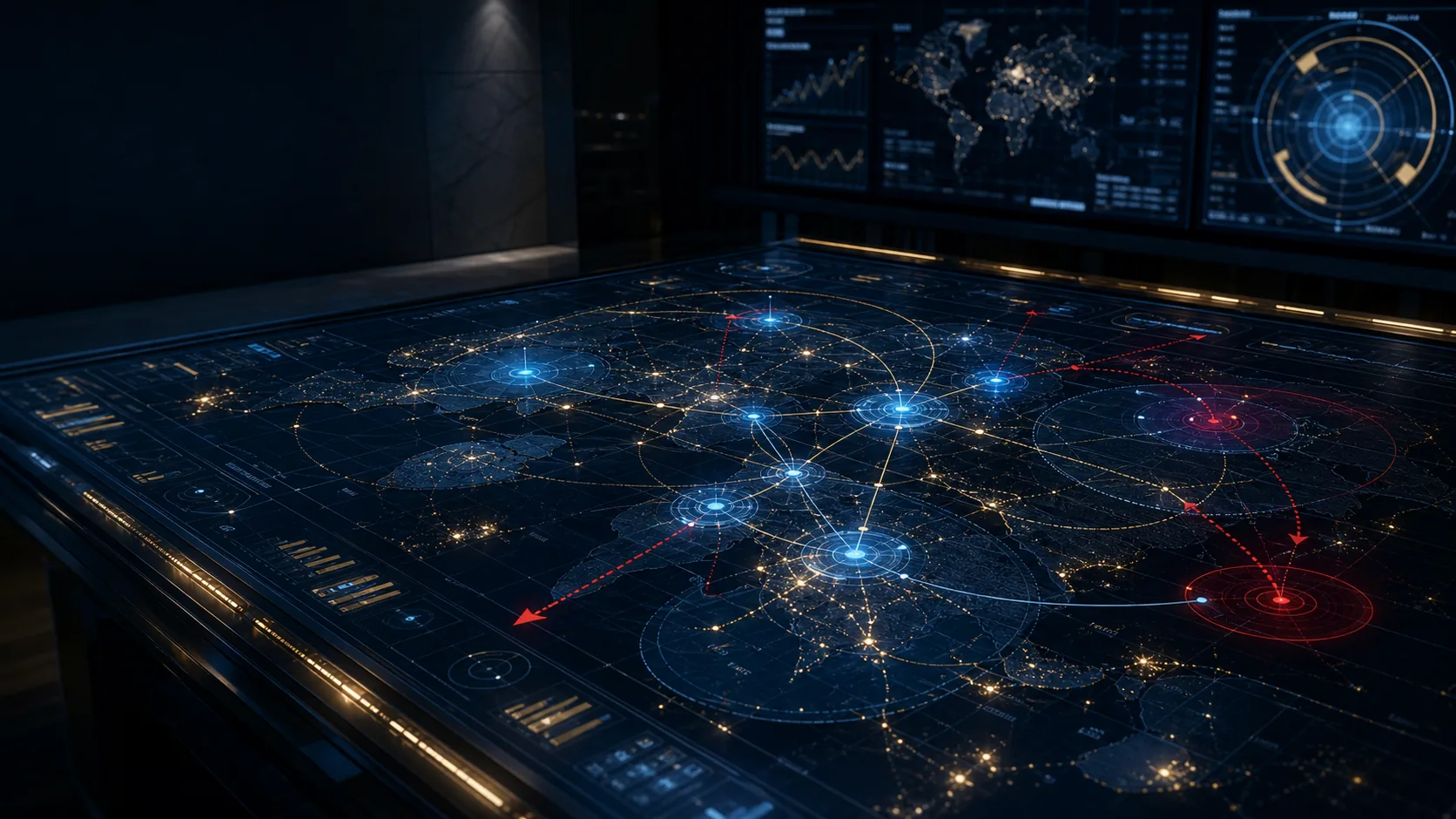
The serious artificial intelligence market is moving from isolated assistants toward control planes that connect agents, business data, applications, workflows, governance, human review, and measurable operating outcomes.
Current product pages from Google, IBM, Microsoft, Salesforce, ServiceNow, and UiPath all point toward the same strategic pattern: agents become more valuable when connected to enterprise context, orchestration, governance, and work systems.
The easy mistake is to judge the visible assistant and miss the system that makes it useful. Executives see a conversation, a dashboard, a workflow builder, or a promise of automation. Operators need to inspect the route behind the promise: where context comes from, which tool can act, who approves exceptions, what evidence is preserved, and which metric proves the work improved.
The control plane is where platform power becomes operating power.
1. The Strategic Reading
In War of the Ecosystems terms, the enterprise ai control plane is becoming the product is not a feature story. It is a control story. The company that controls the trusted context, allowed actions, human review, and feedback loop controls the economic surface where artificial intelligence becomes work.
Platform envelopment and ecosystem command: the winning platform is not only the model or assistant, but the layer that governs context, tool access, workflow state, and accountability across the enterprise.
That is why leaders should stop asking only which vendor has the most impressive demonstration. The stronger question is which ecosystem will own the workflow boundary once the pilot becomes daily operations.
“That is why leaders should stop asking only which vendor has the most impressive demonstration.”
, Dr. Alejandro Canonero, DBA, author of War of the Ecosystems
The article's operating surfaces, shown as a controlled loop rather than a standalone tool.
2. The Operating Loop
A useful workflow has a beginning, a context boundary, a permitted action, an exception route, a human owner, and a measurement path. Without those parts, artificial intelligence can be fluent without being accountable.
The first implementation should be small enough to govern and meaningful enough to matter. The goal is not to prove that automation is possible. The goal is to prove that the organization can command one repeatable lane before it expands autonomy.
That lane should be written down in operational language. What starts the workflow? Which source is trusted? What can the system do? What must it not do? Who owns the exception? What evidence remains after the work is complete?
A publication-ready workflow must show boundaries, ownership, and proof.
3. Battlefield Example: Allied command and control in the Battle of Britain
The advantage was not one aircraft, one radar site, or one radio message. It was the command system that fused signals, allocated scarce resources, and coordinated response.
The military analogy matters because it separates isolated capability from commanded capability. A technology, vehicle, port, radar signal, or agent is not enough. Advantage appears when the capability is connected to routing, control, maintenance, communication, decision rights, and feedback.
The business lesson is direct: more artificial intelligence capacity without operating discipline creates congestion. Governed flow turns capacity into results.
How Allied command and control in the Battle of Britain explains the business control problem.
4. What Leaders Should Build First
Start with one lane. Pick a workflow that repeats, creates visible cost or delay, and already has an accountable owner. Do not begin with a broad transformation statement or a vendor catalog.
The first lane should have approved sources, narrow permissions, a review step, logging, a failure path, and an outcome metric. If any of those pieces are missing, the project is still a draft even if the interface looks polished.
This is where many companies underinvest. They buy or prototype the front end, then discover that policy, data, ownership, and exception handling were never converted into an operating design.
5. Risk And Control Note
The main risk is not only that artificial intelligence gives the wrong answer. The larger risk is that it moves work without a clear control perimeter. That can create silent policy drift, weak accountability, unreviewed customer impact, and poor evidence when something goes wrong.
Controls should not be bolted on after the pilot. They should be part of the pilot. Source-of-record rules, permissions, approval points, monitoring, human override, and rollback are product requirements.
A strong pilot therefore proves both value and governability. If it cannot prove both, it is not ready to scale.
6. Executive Decision
Map which platform controls identity, data access, tool invocation, workflow state, approval, logging, and measurement for one critical process before standardizing the next layer.
Command the workflow first. Then expand the agent, assistant, harness, or platform layer.
Source Evidence
- Introducing Gemini Enterprise
- IBM watsonx Orchestrate
- Microsoft Copilot Studio
- Salesforce Agentforce
- ServiceNow AI Agents
- UiPath Maestro
- RAF Museum: Radar and the Battle of Britain
Independent synthesis by Dr. Alejandro Canonero, DBA. Historical examples are used as strategic analogies. Source organizations do not endorse this interpretation.