 War of the Ecosystems
Request Strategy Session
War of the Ecosystems
Request Strategy Session

Claims organizations do not need an artificial intelligence system that makes accusations. They need an operating system that assembles evidence faster, exposes contradictions clearly, and gives authorized professionals a traceable basis for judgment.
The real operating problem
Claims teams must connect policies, forms, images, correspondence, prior activity, external signals, and fraud indicators under time pressure. The burden is not one prediction. It is the disciplined assembly of evidence.
AI orchestration can classify incoming material, surface inconsistencies, build a chronology, and recommend the next investigative step. The claim decision and any adverse action remain with authorized professionals.
Machine reconnaissance. Human adjudication.
The military counterpoint: Operation Fortitude
Before D-Day, Operation Fortitude used decoys, false radio traffic, double agents, and supporting activity to create a convincing but false picture. The lesson for claims work is not suspicion of every signal. It is that a plausible signal becomes trustworthy only when provenance, context, and corroboration agree.
This is a strategic analogy, not an argument for militarizing a commercial workflow. It makes one coordination problem visible: distributed signals create value only when a trusted operating system connects, tests, and routes them.
Read the historical source from Imperial War Museums.
The documented business proof point
A Microsoft customer case describes Shift Technology using artificial intelligence to sort and classify policy, claim, and supporting documents for faster fraud investigation. The company reports reducing weeks of sorting, classification, and decision support to days while supporting insurers across the policy life cycle.
These are company-reported results from a specific implementation. They demonstrate feasibility; they are not independent validation, a forecast, or a guarantee for another organization.
Read the original deployment source.
The War of the Ecosystems reading
Fraud is an ecosystem contest. Bad actors exploit gaps between channels, documents, partners, and internal teams. Defensive advantage comes from connecting those fragments faster than an adversary can exploit them while keeping authority and explanation with the claims organization.
“Defensive advantage comes from connecting those fragments faster than an adversary can exploit them while keeping authority and explanation with the claims organization.”
, Dr. Alejandro Canonero, DBA, author of War of the Ecosystems
In ecosystem competition, information is part of the battlefield. Trust must be designed through provenance, corroboration, and accountable judgment.
The historical counterpoint makes the coordination pattern visible. The documented business case shows the pattern appearing in modern operations. Together they form a transparent evidence bridge between operating logic, public implementation evidence, and the book's strategic framework.
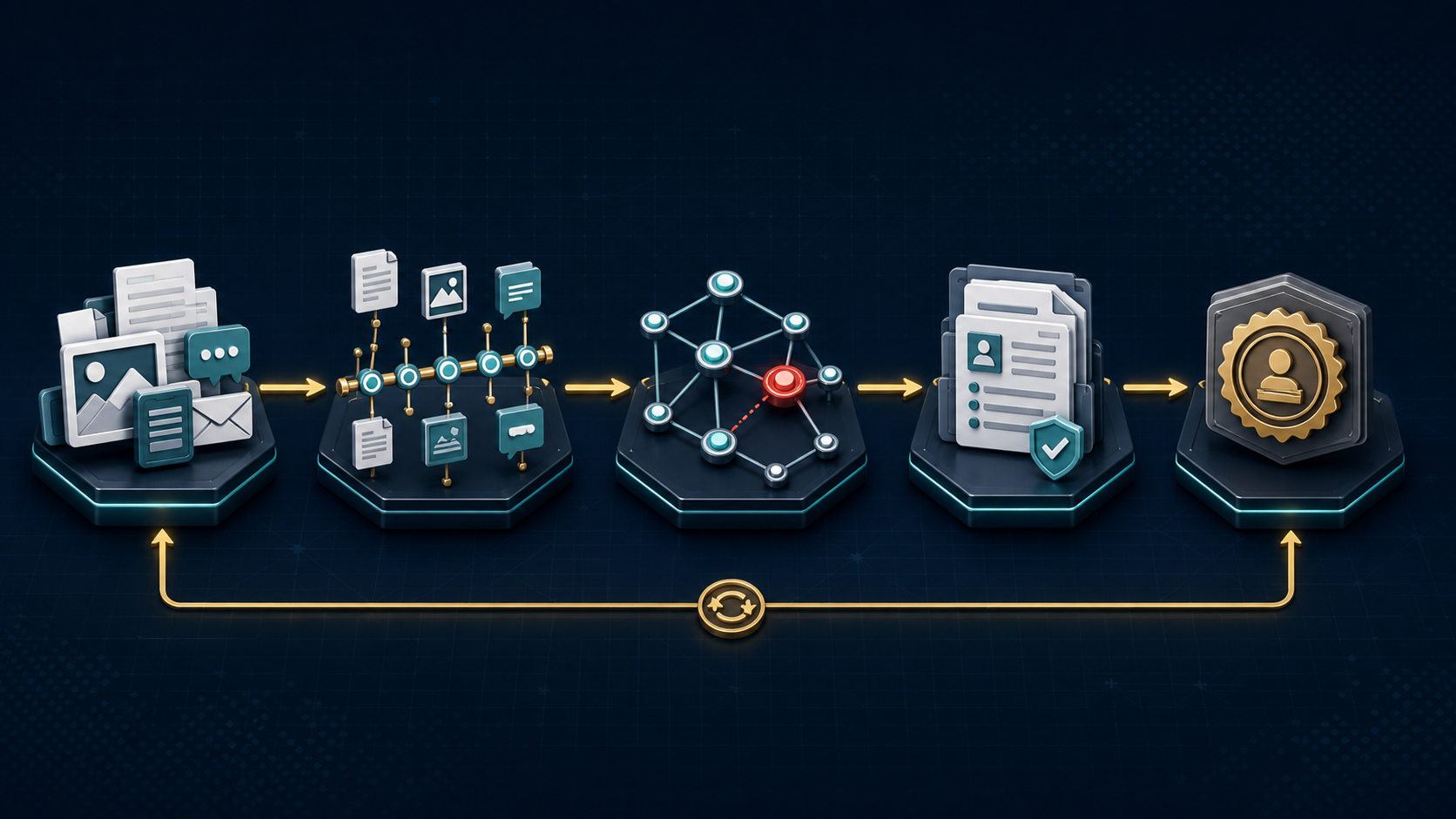
The five-stage operating doctrine
- Ingest the claim. Register forms, images, adjuster notes, messages, and policy context.
- Build the chronology. Normalize dates, parties, events, locations, and prior activity.
- Surface anomalies. Compare evidence, detect contradictions, and rank investigative signals.
- Brief the investigator. Present traceable evidence, uncertainty, and recommended next checks.
- Record the decision. Capture human rationale, disposition, and feedback for monitoring.

What the Ecosystem Commander must govern
The executive dashboard
Non-negotiable control gates
- No autonomous denial or accusation
- Trace every signal to source evidence
- Monitor bias and disparate impact
- Separate investigative priority from claim entitlement
A controlled 90-day route
Recon
Study one claim type, its evidence map, fraud typology, and current investigator queue.
Pilot
Generate evidence chronologies and briefs without changing claim outcomes.
Scale
Add prioritization only after legal, compliance, and fairness review.
The decision
Do not begin by asking which model to buy. Begin by asking which operating loop matters, which participants must coordinate, what evidence can be trusted, where authority must remain human, and how the system will learn.
That is how artificial intelligence moves from isolated capability to ecosystem advantage.
Connected reading
- Explore all 20 AI orchestration use cases
- Read War of the Ecosystems and its central thesis
- Examine the Ecosystem Commander framework
- Review Dr. Alejandro Canonero's executive profile
- Test your operating readiness
Sources and evidence discipline
- Shift Technology helps hundreds of insurers fight claims fraud using Azure OpenAI Service, Microsoft
- D-Day's Parachuting Dummies and Inflatable Tanks, Imperial War Museums
- AI Risk Management Framework, NIST
- ISO/IEC 42001 artificial intelligence management systems, ISO
Independent synthesis by Dr. Alejandro Canonero, DBA. Historical examples are used as strategic analogies. Source organizations do not endorse this interpretation.