_Page_1_Image_0001_edited.jpg)

The Art of Reconnaissance: Winning the War of Ecosystems
- Alejandro Canonero
- Oct 21, 2025
- 5 min read

Updated: Nov 9, 2025
Commanders do not lose campaigns for lack of soldiers. They lose them for lack of truth. History is full of reminders. Napoleon’s march into Russia collapsed because winter, supply lines, and terrain were underestimated. Modern conflicts have stumbled when reconnaissance was shallow or misread. Bad intelligence does not only lose battles; it breaks empires. The same law rules business, innovation, and ecosystem building. Before you deploy capital, teams, or strategy, verify the maps. Step past the glare, challenge assumptions, and bring home the real picture.
A Debrief In Dubai Marina
A few weeks ago, after the ACT event in Dubai, I sat with my colleague Yassine Hosni for an after-work team dinner at Dubai Marina. The skyline glittered with building lights. Yachts moved like quiet patrols. The room carried that precise mix of fatigue and adrenaline that follows a hard day of work on finance, ecosystems, and transformation.
We focused on the reconnaissance phase of any serious project. How do you gather the right data to scope research, define hypotheses, and frame the field of operation? Strip away the noise, and a simple truth remains. The most dangerous enemy is not the absence of data; it is confirmation bias. The mind searches for comfort rather than clarity. We pick the numbers that please us. We quote the charts that fit the story. We ignore the flanks where reality is moving.
This is the streetlight effect in full form. We look for what is easy to see, not for what is true. We run reports. We publish insights. We stay under the light that flatters our position. Real strategy begins where the light ends. It lives in the dark places where new facts contradict our most cherished assumptions.
That calls for humility. Let the evidence that you worked hard to find rewrite your plan. In ecosystems, in leadership, and in science, the worst intelligence is not fake data. It is curated data that props up a theory rather than exposes the reality of the field.
Arrogance and comfort kill curiosity. Curiosity is always the first casualty of bias.
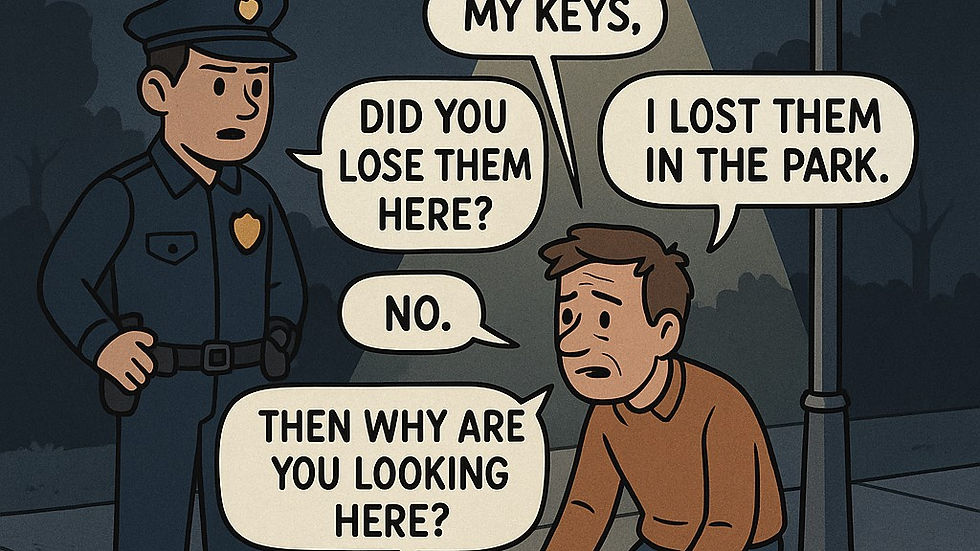
The Streetlight Parable
A police officer sees a man searching under a streetlight late at night. The officer asks, "What are you looking for?" The man answers, "My keys." The officer asks, "Did you lose them here?" The man says, "No, I lost them in the park." The officer asks, "Then why are you looking here?" The man says, "Because the light is better here." https://tapandesai.com/streetlight-effect/
If you only patrol the bright zones, you will miss the movement in the dark. Diversify your sources. Cross-check collection methods. Validate how the numbers were produced. Then interrogate them as if they were witnesses.
Black Boxes And False Confidence
We live in an age of black boxes. Models generate scores. Dashboards present simple stories. Advisors and feeds arrive with confident answers. Ask the only questions that matter:
How did you get this result?
What data went in?
What was excluded?
What assumptions shaped the transformation?
If there is no transparency, there is no trust. The same rule applies to news feeds. We want facts that are not tampered with. Wrong information sets off chain reactions. Elections tilt. Markets swing. Careers and companies pay the price.
Many of the loudest gurus and truth-tellers of today did not see Amazon entering enterprise technology. They dismissed the AWS cloud. They ignored the power of the AWS Marketplace for software distribution. I watched them from the front line. The signals were there, under their noses, but not under the easy light. They refused to accept what they did not want to believe. None wanted to even partner with us, let alone become part of the clichés and old boys' clubs. They are still collecting lost teeth since then, but using the old numbers like new data.

Market Research: The Commander’s Recon
Market research is the work of gathering intelligence on customers, competitors, and the terrain of trends. This allows you to make smarter calls on product, pricing, and go-to-market strategies. Do it right, and you reduce guesswork, test demand early, and move with confidence. Do it wrong, and you build for the wrong customer, miss real openings, and make large bets on bad assumptions.
This is why many leadership teams bring in action-connected market research specialists, not people who just regurgitate other people's data. A good research partner clarifies the mission, designs clean collection methods, detects patterns early, and translates findings into action when time is short. The goal is not a thicker deck; the goal is a decision that survives contact with reality.
The Commander’s Rule Of Intelligence
One. Collect beyond the light. Expand your sources, your formats, and your time windows.
Two. Separate collection from interpretation. First gather cleanly, then analyze.
Three. Reward disconfirmation. Promote the analyst who breaks your favorite hypothesis with solid proof.
Four. Audit the pipeline. At every stage, record how data is selected, cleaned, transformed, and presented.
Five. Publish the method. A decision that cannot defend its method will not defend your position.
Six. Decide on decision-making thresholds before you see the data. Agree in advance on what will count as go, no-go, and pivot.
Seven. Rehearse the ambush from a stakeholder with the opposite perspective or conflicting agenda.
Ask:
What if the opposite is true?
What if the silent segment moves?
What if the partner changes incentives?
Victory favors the vigilant. Shun black boxes. Demand transparency. Diversify your pipelines. Embrace the discomfort of contradiction. Let curiosity lead the patrol.
In the War of the Ecosystems, the battle is won in the reconnaissance tent, not at the press conference.

Scouting The Scouts
Here is a set of public lists that rank research firms. Treat these as a reconnaissance waypoint, not a final target. Use them to generate a long list, then run your own filters based on mission fit, data access, methodology, sector depth, geographic coverage, and speed to insight.
Naturally, you will perform your own research before blindly trusting data that is posted on social networks and the internet, right?
Use a simple screening drill.
One. Check methodology transparency. If there is no clarity on sample, instrument, time frame, and weighting, stop.
Two. Check sector and region match. Experience in ecosystems, AI, cloud, and SaaS matters.
Three. Check data rights. Confirm ownership and reuse terms for raw data and derived models.
Four. Check speed and iteration. Weekly cycles beat quarterly rituals.
Five. Run a blind backtest. Give the firm a historical window and see if their method would have caught the signals you know were true.
What Did I Find With A Simple Search?
Here is a list of 10 sites with their own Top 10 Rankings for Market Research Firms. Take your pick.
In the relentless pursuit of victory, remember: the battlefield of ecosystems is unforgiving. Equip yourself with the right intelligence, challenge your assumptions, and act decisively. The future belongs to those who dare to venture beyond the light.


Comments