_Page_1_Image_0001_edited.jpg)

How the War of AI Ecosystems is Evolving in Saudi Arabia
- Alejandro Canonero
- Dec 12, 2025
- 6 min read

Updated: May 17
Lessons from BytePlus AI Day Riyadh: A Strategic Analysis
By Dr. Alejandro Canonero

Executive Summary: A New Era of AI Strategy
Most countries approach artificial intelligence as a mere technology upgrade. However, Saudi Arabia is treating it as strategic terrain.
At BytePlus AI Day in Riyadh, what unfolded was not just a showcase of isolated tools or speculative futures. It was a coordinated demonstration of how AI is already delivering measurable results across government, enterprise, creative industries, and infrastructure, today, at scale. Through sovereign data platforms, locally anchored compute, generative media systems, and agent-native workflows, Saudi Arabia is assembling the operating system of its future economy.
BytePlus, working alongside MOBILY, Balady, NVIDIA, Lenovo, and Alat, among many strategic partners, is positioning itself as the invisible coordination layer that allows this system to function as a whole.
This article analyzes the event through the lens of ecosystem strategy, drawing on the frameworks of War of the Ecosystems, and shows why the real AI race is no longer about models or features, but about who can orchestrate durable, outcome-driven ecosystems.
The Invisible Battlefield: Understanding the Underlying Dynamics
Wars are rarely decided where the public is looking. In the Second World War, the Allied victory in Europe is often symbolized by the Normandy landings. Yet historians agree that D-Day succeeded not because of what happened on the beaches, but because of what transpired long before and far behind them.
Radar systems, logistics networks, convoy coordination, industrial supply chains, and command structures allowed millions of people, vehicles, and decisions to move as one system. The decisive advantage was not firepower. It was orchestration.
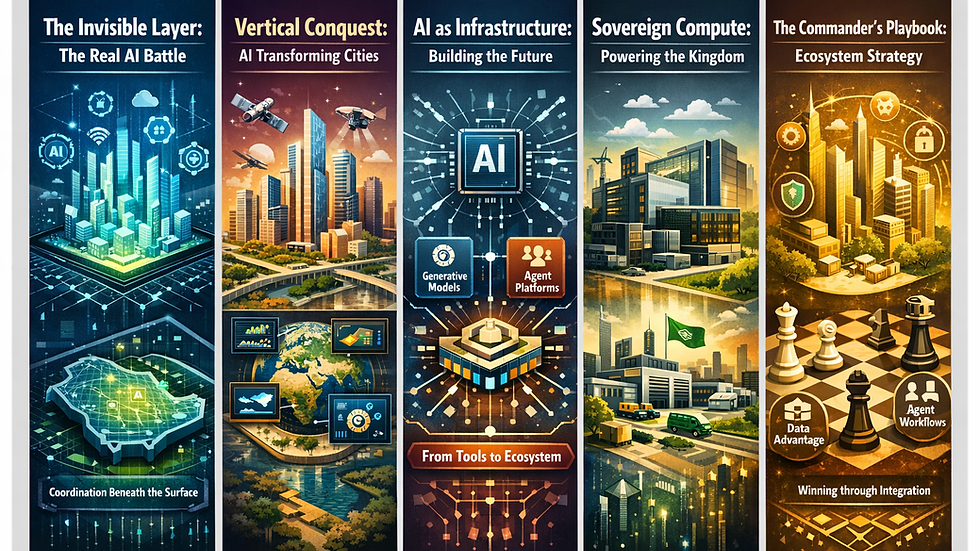
The same pattern is now emerging in artificial intelligence. Saudi Arabia’s transformation has been highly visible. Mega-projects, infrastructure, new cities, logistics corridors. But BytePlus AI Day revealed that the next phase of competition is happening beneath the surface, in what speakers repeatedly described as the invisible layer.
Recommendation engines, generative video pipelines, and multimodal understanding systems are AI acting on behalf of users and institutions. These are not consumer novelties; they are the coordination mechanisms of modern economies.
The strategic challenge for leaders is clear: Create Value! Most organizations invest in AI to improve productivity or reduce costs, yet too many initiatives stall as pilots or disconnected tools. Value does not compound. In War of the Ecosystems, this is a classic failure mode. Ecosystems are not won through superior components in isolation, but through coordinated systems that reinforce one another over time. BytePlus AI Day made the case that in Saudi Arabia, they understand this distinction.
Romantic Practicality: When Vision Meets Results
What distinguished the event was not its ambition. Ambition is abundant in AI forums. What set it apart was something rarer: romantic practicality.
Romantic, because the vision was bold and national in scope. Practical, because every major presentation anchored that vision in systems already deployed, metrics already improving, and economics already changing. Across keynotes, technical sessions, panels, and creative showcases, one pattern repeated itself: AI was not justified by its potential. AI was justified by its present outcomes.
Cities as Platforms, Not Projects: A New Paradigm
A clear example came from Balady. Municipal operations are among the least forgiving environments for technology. There is no tolerance for hype when cities must be inspected, regulated, and maintained every day.
Balady presented a transformation of municipal operations into a data and AI platform. Through computer vision, geospatial intelligence, and agent-based decision support, inspection coverage expanded dramatically, manual effort declined, and response times improved. Costs fell. Traffic congestion dropped. Accountability increased.
More important than any single metric was the structural shift. Urban data was no longer treated as exhaust; it became an asset. In ecosystem terms, this is vertical conquest. Cities are becoming producers of economic intelligence that can power logistics, real estate, environmental services, and future AI-native industries. This is where smart city rhetoric gives way to operational truth. Not dashboards. Not pilots. Systems that work.
Generative Media Has Entered Production: The Industrial Revolution of Content
The sessions on generative media and AI-generated video signaled another inflection point. Generative content is no longer experimental; it is industrial.
Advances in diffusion and transformer-based architectures now allow organizations to generate cinematic video with controlled camera movement, lighting, character consistency, and narrative structure. Static images can be transformed into animated assets. Brand identities can be preserved across formats.
The implications are immediate. Content creation cycles compress from weeks to minutes. Production costs collapse. Teams shift spending away from creation toward testing, iteration, and optimization. This matters because video is no longer just a format; it is the dominant interface of the digital economy.
As NVIDIA’s technical session made clear, AI-generated video accelerates a familiar flywheel. Creation leads to distribution. Distribution generates interaction data. Interaction data improves understanding. Understanding improves creation. What changes is the speed of the loop. Organizations that learn faster than competitors gain durable advantage. In ecosystem warfare, learning velocity is power.
From Product to Enabler: BytePlus is unbundling ByteDance's internal stack. The same recommendation engines and video toolkits that power TikTok are now available to Saudi enterprises to build their own "Super Apps."
From Media to Action: The Rise of Agents in Ecosystem Warfare
Perhaps the most underappreciated insight of the day was how generative media is converging with agentic systems. Across multiple sessions, AI agents were shown moving beyond passive assistance into active orchestration.
These systems interpret intent, select or generate content, execute workflows, and learn from outcomes. In customer service, agent-driven workflows significantly improve resolution rates. In commerce, personalization scales without linear increases in headcount. In operations, small teams manage complexity that once required large organizations.
This marks a strategic shift. AI stops being a tool; it becomes a participant in the value chain. BytePlus’s agent platforms, combined with its generative models, illustrate how repeatable advantage is built—not through one-off automation, but through systems that act continuously.
Infrastructure Is Strategy: The Backbone of AI Success
The excitement around AI often obscures an uncomfortable truth: realism comes at a cost. As NVIDIA highlighted, modern generative models require orders of magnitude more compute than earlier systems. Cinematic video, multimodal reasoning, and agent orchestration are not lightweight workloads.
This is why the fireside discussion with Lenovo and Alat mattered. Local manufacturing of AI servers, data residency, and energy availability are not geopolitical talking points; they are operational necessities. Without them, none of the AI systems discussed can scale reliably.
In historical terms, this is the logistics lesson again. You do not win by having advanced capabilities. You win by being able to deploy and sustain them. Saudi Arabia’s energy advantage and commitment to sovereign infrastructure provide strategic depth that many regions lack.
WhatWar of the Ecosystems Explains About This Moment*
The patterns revealed at BytePlus AI Day map directly to the core arguments of my book, War of the Ecosystems.
First, platforms win when they reduce friction for others. BytePlus is not leading with features but with infrastructure that partners, enterprises, and governments can build on. Second, data becomes power only when it is governed. Balady’s approach shows how trusted, sovereign, well-structured data creates compounding advantage.
Third, ecosystems outperform pipelines. Agent-native systems replace linear workflows, allowing value to circulate rather than terminate. Fourth, ease of doing business is decisive. Low-code agents, controllable models, and production-grade governance make participation scalable.
Finally, winners measure what compounds. Not just cost savings, but learning velocity, partner contribution, and reuse of digital assets. This is not accidental alignment; it is ecosystem logic at work.
The War Story That Matters: Lessons from History
The spirit of this moment is best captured not by D-Day itself, but by what followed. After the Normandy landings, the Allies faced a different challenge: speed. They needed to move supplies, fuel, and decisions across Europe faster than the enemy could respond.
The solution was not a single weapon, but an integrated system of ports, pipelines, railways, and command structures that turned momentum into inevitability. Saudi Arabia’s AI strategy reflects the same insight. Models alone do not win. Data alone does not win. Infrastructure alone does not win. Victory comes from coordination.
Why This Matters Now: The Urgency of Ecosystem Strategy
For CEOs, CIOs, and ecosystem leaders, the message from Riyadh is unambiguous. AI is already delivering tangible results. Generative media is already changing cost structures. Agents are already reshaping customer and operational workflows. Infrastructure decisions made today will determine who can compete tomorrow.
This is no longer about experimentation; it is about positioning. Those who build ecosystems will shape markets. Those who buy tools will rent relevance.
Key Takeaways for Ecosystem Commanders
AI advantage comes from orchestration, not isolated innovation.
Cities and governments can become powerful data platforms.
Generative media has crossed into industrial production.
Agent-native systems are becoming the new interface.
Sovereign infrastructure is a competitive asset.
Learning velocity, not model quality alone, determines winners.
Saudi Arabia is not merely adopting artificial intelligence. It is shaping the battlefield on which AI competition will be fought. In the war of ecosystems, that is how victories are won.


Comments